Tāwharanui Regional Park: Visiting the Open Sanctuary
A 588-hectare open sanctuary behind a 2.5 km pest-proof fence, 90 km north of Auckland: the drive, the gate hours, beaches, farm, tracks and camping.
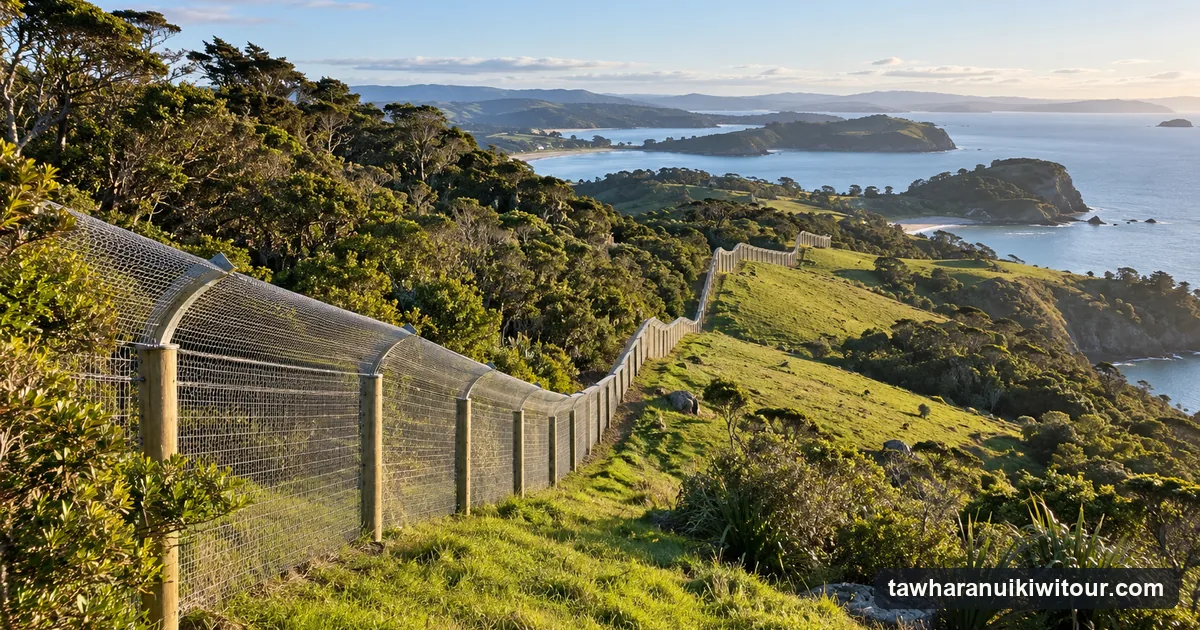
Tāwharanui Regional Park covers 588 hectares at the very end of Takatu Road, about 90 km and an hour and a half north of central Auckland, past Matakana. It was New Zealand’s first integrated open sanctuary, where farming, public recreation and conservation share the same land, and a 2.5 km pest-proof fence runs across the peninsula from coast to coast. Parking is free and the park is open to the public. After dark, the kiwi come out.
The name refers to “the abundant edible bracts of the kiekie vine”, and an old saying pairs that harvest with the snapper offshore: he whā tāwhara ki uta, he kiko tāmure ki tai, the flowering bracts of the kiekie on the land, the flesh of the snapper in the sea.
Getting there from Auckland
Take State Highway 1 north to Warkworth and follow the signs to Matakana. Just past Matakana, turn right at the Ōmaha turn-off onto Takatu Road; the park is about 13 km along it. Drive on through the predator-proof fence to Anchor Bay, where the main car park has 200 spaces. Allow an hour and a quarter to an hour and a half each way.
There are no townships or stores near the park, so bring food and water. Matakana, on the way, is where the dinner tour run by Auckland and Beyond Limited eats before its walk.
The gate rule
The automatic gate at the park entrance lets vehicles in from 6am to 9pm during daylight saving (27 September 2026 to 4 April 2027 this season) and from 6am to 7pm otherwise. It opens for any vehicle leaving, at any hour, but nobody is let in after closing. Combination codes don’t work on the main gate, and even the emergency opening is exit-only.
So for an evening visit, drive in before the gate shuts and leave whenever you like. Where a listing calls the park open 24 hours, that means on foot.
The open sanctuary
The fence was finished in 2004, part-funded by the Tāwharanui Open Sanctuary Society, and that year the regional council dropped bait across the peninsula by helicopter. The sanctuary officially opened in March 2006. It is kept pest-free by eradication and monitoring: tracking tunnels and cameras pick up any incursion, and species-trained dogs and trapping deal with it. Incursions have been rare, but they happen. The sanctuary is managed, not sealed.
The society runs the sanctuary as a joint project with Auckland Council. The land was bought in 1973 by the former Auckland Regional Authority, after a century of farming by the Martin, Jones and Young families, and it is still a working farm, with sheep and cattle on the pasture.
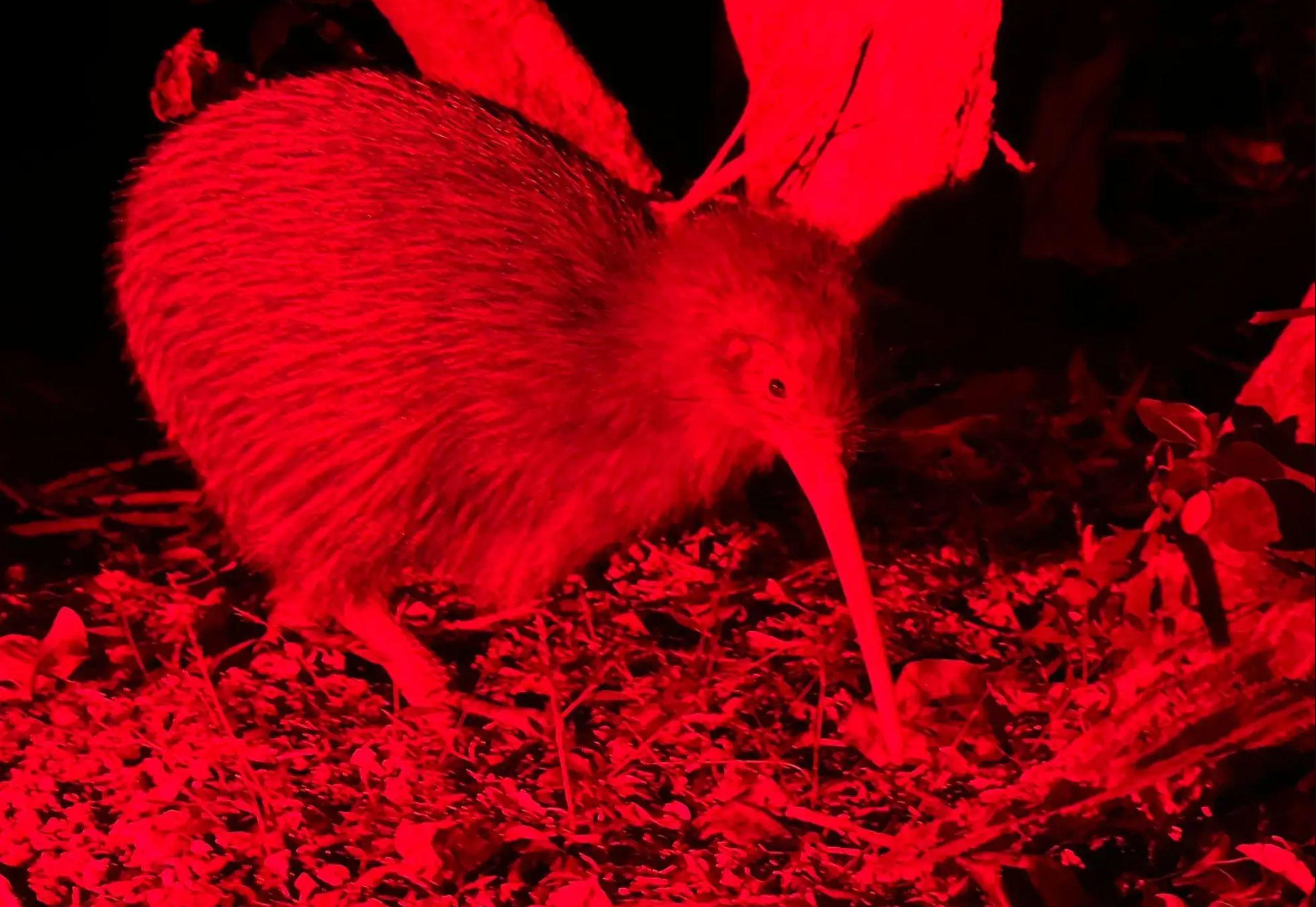
Kiwi are the headline. Fifteen North Island brown kiwi released in November 2006 were the first on the Auckland mainland in around 60 years, and the society now estimates about 300. Other birds came back too. Bellbirds flew over on their own from Little Barrier Island in 2005 and are now the most numerous bird in the park, and kākā returned by themselves. Takahē, pāteke (brown teal), tīeke (saddleback), toutouwai (North Island robin), pōpokotea (whitehead) and kākāriki were brought in. Ruru (morepork) are about at night, and grey-faced petrels nest in burrows.
Seeing the kiwi
You can walk the park after dark on your own with a red-filtered torch, if you are inside before the gate shuts and keep to the rules: no flash, no spotlights, stay on the track. The simpler way to see a kiwi is with a guide. The walk run by Social Nature Movement (SNM) meets at the Anchor Bay toilets after dusk and supplies red torches, and its pitch is guides who know where the birds feed. It is from about $62 on the booking platform when we checked, rated 4.8 over 146 reviews. No one can guarantee a sighting.
Beaches, tracks and rules
Anchor Bay is named after the anchor of the Phoenix, a ship wrecked on this coast in 1879. Its Māori name, Waikōkōwai, marks a source of kōkōwai, red ochre. The north coast is the Tāwharanui Marine Reserve, where fishing is not allowed.
The Council’s park map gives these walks:
- Ecology Trail: 4 km and 2 hours return, from the Sanctuary Hut at Anchor Bay, on yellow markers.
- Mangatawhiri Track: 1.2 km, 20 to 30 minutes return.
- West End Track: 6 km, 3 hours return.
- Māori Bay Coast Walk: 7 km, 4 hours return, at mid to low tide only.
There are ten vault toilet blocks, accessible toilets at Anchor Bay, and cold showers. No dogs or other animals are allowed anywhere in the park, even inside a car, and drones are banned. Check your car and gear for pests before you come, and keep food where the pūkeko can’t get at it.
Don’t plan around glow-worms: some maps of the park mention a glow-worm walk in Waterfall Gully, but that track is at Shakespear Regional Park.
Camping and the bach
The Council’s campground has vehicle access and is open all year, with tents-only and all-modes areas but no dedicated parking for self-contained vehicles. The Council advises booking early for summer. At night, campers can hear kiwi calling. The Tāwharanui Bach at Jones Bay, near the entrance, sleeps up to six.
SNM’s kiwi walk has a glamping option in its own bell tents; the campsite is a separate booking with the Council, and its fees are extra.
What happens on a Tāwharanui kiwi walk covers the night itself, and the best time to see kiwi the timing. Weighing Tāwharanui against Tiritiri Matangi or the zoo? Read where to see kiwi near Auckland. The homepage has every bookable option.
Facts from Auckland Council’s park page, map and park rules, the Department of Conservation, the Tāwharanui Open Sanctuary Society and the Predator Free NZ Trust. Checked October 2026.
Book the Tāwharanui Kiwi Walk
Two hours on foot after dark in Tāwharanui's pest-free open sanctuary, with a guide who listens for calls and red-light torches for everyone. Rated 4.8/5 from 146 verified reviews, with free cancellation up to 24 hours before. Meet at the Anchor Bay car park, or add transport from central Auckland when you book. The kiwi are wild, so a sighting is never guaranteed.
Check Availability & Book